
“Utopia was here at last: its novelty had not yet been assailed by the supreme enemy of all Utopias — boredom.” – Childhood’s End, Arthur C. Clarke
I just wrapped Arthur C. Clarke’s famous novel Childhood’s End. If you haven’t read this, and are even the slightest bit interested in Science-Fiction, you should go for it. It has that Ray Bradbury element I love so much in my Sci-Fi, of being a human story first and foremost. It isn’t dense with invented words or scientific concepts, and is well-written (and at times indeed poetic), while utilizing plain English accessible to every reader.
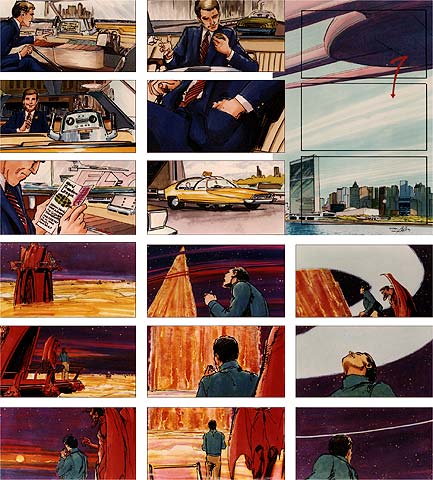
What if, at the height of the space race just as humanity was beginning to audaciously head towards the stars, massive alien spacecraft arrived at Earth? They are vastly superior to humans, that much is obvious. They don’t show themselves, but they make their message clear: they are here to help and only want the best for humanity. But what if shepherding in a golden age of humanity thwarts human potential? What are these overlord’s true plans for humanity and why won’t they let us see them?
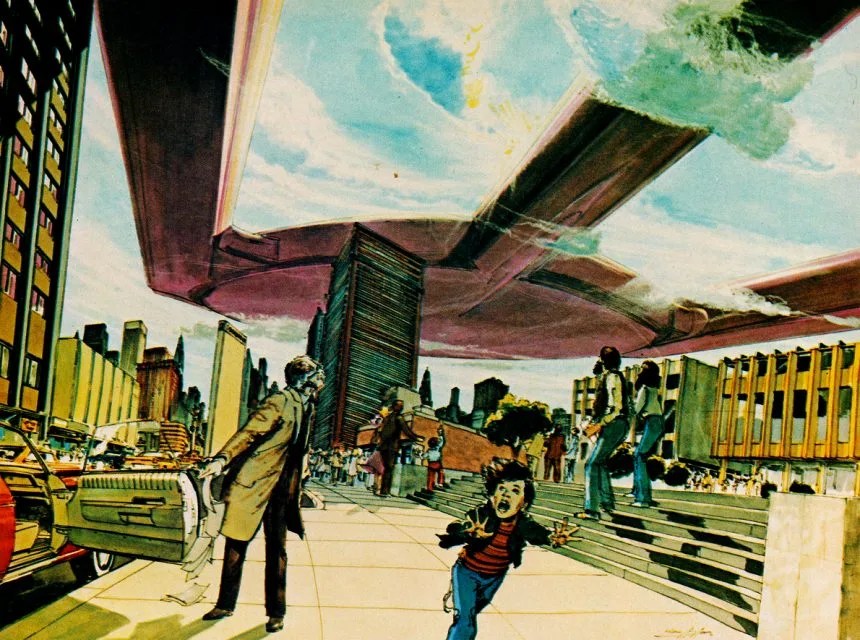
Childhood’s End starts from there, and explores the politics and human psychology of that scenario. The best part though, is the ability Clarke has to continually change the story’s direction, expanding past the initial premise and sparking renewed curiosity and excitement with each pivot. The story unfolds itself effortlessly, and the realistic portrayal of how our species would behave in each circumstance draws you in over and over again. I was blown away by how easily Clarke entertains, while still presenting thoughtful and heavy philosophical explorations (there is a reason he is known as one of the “big three” of Science Fiction). It has the best tropes of Science-Fiction even as it finds surprising new directions (published in 1952, yet it felt fresh to me).
I want to go into more detail but that would ruin the fun for future readers, so instead I will emphasize that beyond the first chapter or so (where the set up recounted above is laid out) are a dozen more spectacular and thought provoking plot points that continually redouble your interest in the story.
Here are a few of the predictions Childhood’s End makes about the “golden age” of humanity. I recommend reading the list below only if you have already read the book, don’t plan to read the book, or don’t care about minor spoilers (though I have excluded anything central to the plot). Keep in mind, some of the predictions below are the consequence of an explicit event within the book rather than predictions of “normal” human progression.
- Humans still eat meat, but no longer participate in any recreational cruelty towards animals (bull fighting, hunting for sport, etc)
- All of the world’s religions flicker out. Buddhism hangs on the longest.
- People work about twenty hours a week, and not out of financial necessity. All essentials, and indeed nearly all physical goods, are free due to the infinitesimally cheap cost of production. People can own any house they want, any car they desire, and classes are indistinguishable. Work of routine and mechanical nature is left to machines. Human work is that which solely relies on the mind. There are factories that run for weeks without a single human visitor or supervisor.
- Personal helicopters seem to have usurped the dominance of cars, at least for long distance travel.
- Professional athletes are all but extinct, because with the increase in free time, amateurs are nearly as skilled at most sports. About a quarter of human free time is spent playing sports of various kinds, ranging from chess to more “lethal pursuits” like skiing.
- There is one world government and English wins out as the dominant human language.
- Entertainment is hugely popular, and most people spend a good portion of their free time consuming films and other TV.
- People can live anywhere they want, worldround. Most people have two homes in widely separated parts of the world. Some people choose extremely exotic places for their homes, like below the ocean or on Mount Everest. The polar regions have been “opened up”, and many people oscillate between the Arctic and Antarctica at six-monthly intervals (“seeking the long, nightless polar summer”).
- Newspapers are printed directly in people’s homes. But the news is boring. This is because there is virtually no crime or war, and all disease and sickness has been eradicated. When the occasional serious crime does occur, it does not receive media attention (“for well-bred people do not, after all, care to read about the social gaffes of others”). The most “exciting” headline you might see in the future is when someone’s exotic home collapses on them.
- People spend more time on their education, and it is much more thorough. Most students attend college in their late teens and early twenties, and then go back around age 25 for a second degree for three years (after travel and experience has broadened their minds). After that, adults continue to take refresher courses in their favorite subjects.
- The kitchen is obsolete within the home. When people want food, they order it from a central agency, and shortly after it arrives at their door.
That is all for now. Like I said, I highly recommend you give it a read. It is so entertaining that it only took me three days. I’ve left my Stephen King phase and now plan to read some Science-Fiction, so please leave a recommendation if you have one. I’ve read some of the big Sci-Fi, but please recommend whether you guess I’ve read it or not!
 polymathematics
Leave a comment