

“If I knew where the good ideas came from I would go there more often.”
-Leonard Cohen
There has been a creative resurgence. It can be noticed nearly anywhere. Podcasts, books, blog posts, Instagram bios: everyone is either praising or claiming the title creative. Maybe it isn’t really a resurgence? Not sure yet…
If it is real, I do know the resurgence is quite meta though, many people have happily created content that comments on creativity. There are great versions of this (Chase Jarvis, Gary Vaynerchuck, Debbie Millman) and some not so great versions (redacted). The worst versions are vague and abstract, relying on platitudes like “creativity takes courage” (sorry Matisse). The platitudes are often true and can be interesting if explored deeply and specifically, but they usually appear in the shallow end of thought.
The reason it is so difficult to stay grounded in reality when discussing art is because art itself is abstract and sometimes ineffable. It is like explaining a LSD trip or a dream to someone else. But the key to discussing art and creativity well, the key that the people mentioned above have discovered, is to get specific quickly. The best commentators on creativity give actionable takeaways like how to overcome writer’s block or how to sell your first project. These are extremely valuable, but I want to try to do what the shallow versions try to do. I want to explore where ideas come from, and do so without floating up into the stratosphere where they might be hiding.
I listen to a lot of interviews. It is my favorite way to procrastinate when I am having trouble finding ideas. Inevitably, during the question and answer portion of an artist interview, some audience member asks a question that distills to where do you get such great ideas? This provokes many humorous responses and occasionally some very poor abstract mumbling. When asked a variation of this question, Neil Gaiman had an amazing response to what he called the question that must not be asked of writers.
He jokes that writers “don’t really know” where they get their good ideas from, but what he follows with is actually very helpful and points to the essence of “finding” ideas. He quickly mentions that ideas often come from “two things sort of flowing together.” Granted, we are dangerously close to the shallow abstractness aforewarned. But this explanation of Gaiman’s process is actually a fundamental exercise that can be used to find ideas. Blurring of two seemingly unrelated concepts has created great art. I googled “best books of all time” and “best movies of all time” and found some that match this rubric.
Animal Farm, George Orwell: Russian Revolution, but farm animals!
Fahrenheit 451, Ray Bradbury: Firefighters, but it’s the future where fires are preventable so they start fires instead of stopping them.
The Matrix, The Wachowskis: Descartes, but in the future!
Toy Story, Pixar: Toys, but they’re…alive!!!!
Her, Spike Jonze: A love story, but with a computer.
Granted this idea doesn’t account for many many great works of art and the works that it does fit are more complex than two ideas, but it is a strong point for a starting point. So this might be what Neil meant. In the video, he goes on to give a delightful example of how he might come up with an idea, starting with the idea of a werewolf and applying it to a chair. The point this should illustrate to any artist or hopeful creative is that you must actually spend time hunting ideas. Seems obvious, but how often have you actually sat down and tried to think of something new? How often have you actually devoted time to thinking of interesting concepts? Most people don’t really do this, even if they describe themselves as creative. I am reminded of the Jack London line “You can’t wait for inspiration. You have to go after it with a club.” Somewhat defeated, Gaiman ends with “I don’t know, you make em up out of your head.” It really is hard to explain…
So the blending of two worlds is one exercise that leads to ideas. Another great one I found comes from Gregory Corso, infamous beatnik and friend of Ginsberg and Kerouac. It is sort of a variation of the blending method, but adds a third ingredient to blend. Corso would, so the stories go, spend hours in the White Horse Tavern of the West Village getting drunk and drawing strange triangles. On closer inspection though, he was doing much more than bad trigonometry. He would draw a triangle on some hoppy napkin, and then think of three famous artists who would make an interesting collaboration. One name on each little point of the triangle. Look at the photo below and try to imagine what he was thinking might come from these ahistoric creative teams.
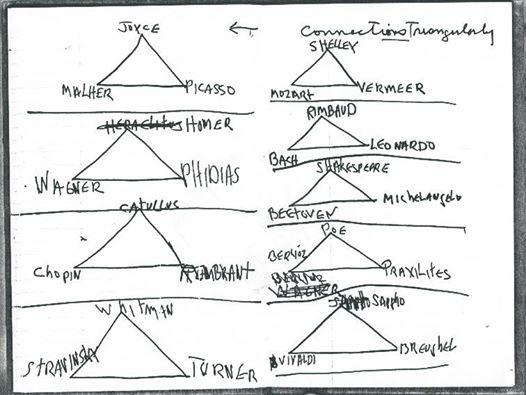
I absolutely love this exercise and have adopted it as my own. I even do it with stories, concepts, objects, or places. For instance, flipping through my notebook I find one triangle…
2038
Suburbs
Mars
Another…
Coffee Shop
Dreams
Bladerunner
It can inspire some very fun stories and worlds, and if anything is a helpful warmup exercise. Above we could have a coffee shop in some dystopia where the depressed and oppressed citizens pay $4.50 for dreams in a cup. I also find it insightful to try and make a triangle for a story you’ve already made or are working on. If it doesn’t fit that well perhaps you have too many ideas. Let’s do some and then guess what famous story it could be.
War and Politics
Religious Order/Magic
Space
Star Wars. Replace space with London and you have Harry Potter. One more…
Janitor
Genius
Boston
Good Will Hunting.
Of course this is an exercise, and is necessarily reductive. But it has proven to be a strong tool for making my concepts clearer and precise, and even explaining an idea to someone else. I’ll wrap up with one more simple exercise before some closing thoughts. I sometimes start a writing session with word association. It can be random or based around the stories theme, but it can help to get away from usual phrases and word choices. For that reason I find it especially good for poetry. Here is one simple chain:
Evening
Drift
Wind
Cloud
Rain
Spring
Sunlight
This might turn into some odd poem.
The Evening Drift happens by my window,
Melts and joins the butter on my food.
I see the cloud above my house turn from red to blue,
And then from blue to suburban green,
As the sunlight evaporates off and up
with the rain of Spring.
Fun, quick, simple, new. The word associations allowed for the theme, and the rest was simply adding some rhyme and structure. A few more techniques I haven’t yet tried but have heard of:
1.) Imagining a conversation between friends or famous characters or people. This is the Platonian Model.
2.) Take your story or world and just deep dive on the following:
- Political groups
- Religion
- Economic Classes
- Entertainment, Drugs, Food
- Transportation, Medicine, Sex, etc…
3.) Altering a real memory. This is the “what if?” model.
Beware though, these techniques can create a way overproduced and phony feel. I will relay the warning H.G Wells issued in The Time Machine: if a character is truly new to a world they won’t know every detail of that new world. They will only catch strange glimpses from their interactions and experiences and attempt to piece it together. So don’t over explain your world, leave some things to wonder about.
This is similar to the advice Ray Bradbury gives in the original introduction to Dandelion Wine when discussing the notorious question that must not be asked of writers. An interesting connection is that Gaiman wrote the introduction to the newest reissue of Fahrenheit 451! I was happily surprised to discover he too used word association (great by association?).
“This book like most of my books and stories, was a surprise. I began to learn the nature of such surprises, thank God, when I was fairly young as a writer. Before that, like every beginner, I thought you could beat, pummel, and thrash an idea into existence. Under such treatment, of course, any decent idea folds up its paws, turns on its back, fixes its eyes on eternity, and dies. It was with great relief, then, that in my early twenties I floundered into a word-association process in which I simply got out of bed each morning, walked to my desk, and put down any word or series of words that happened along in my head. I would then take arms against the word, or for it, and bring on an assortment of characters to weigh the word and show me its meaning in my own life. An hour or two hours later, to my amazement, a new story would be finished and done. The surprise was total and lovely. I soon found that I would have to work this way for the rest of my life.”
The process of finding ideas is a deeply personal and strange experience, this is the very reason the creative resurgence has been saturated with vagueness. It relies on a concept of mystery, luck, and spontaneity. Indeed, there is a bit of tension between Bradbury’s art as surprise and my connecting him to disciplined idea hunting. There is certainly some truth in the platitude don’t overthink it. Art and creativity seem to be the most powerful when the feeling that inspired them is real and even cathartic, not planned and worked on over and over. If you remain with that view of creativity then you can think of this post and these techniques when you feel stuck, or want to warm up; as tricks to keep up your sleeve that will often allow your brain to “stumble” upon the real and magic inspiration that has been so mystified. But I think the tension is resolved by the larger truth that inspiration won’t find you, you must go after it. Creatives are prone to procrastination and waiting, and these exercises and techniques are about imposing structure and discipline to your creative process. Without discipline you may be left waiting for a guest that will never arrive. You must position yourself to be “ready” when the muse hits, and to do that “it” must find you working or having just done work.
This tension and my proposed resolution is partly the topic of The Eureka Moment, an amazing article by Guenther Knoblich and Michael Oellinger that I first read in Scientific American. They talk about Albert Einstein and other famous thinkers “stumbling” onto their breakthrough ideas. These are the stories like Friedrich August Kekule day-dreaming and seeing a snake biting its own tail only to discover the structure of aromatic molecules (low energy cyclic rings), Ramanujan being visited by the Hindu goddess Namagiri and showing him mathematical proofs, Einstein on his bus ride dreaming up the speed of light and its relation to time, or Doc from Back to the Future hitting his head and inventing the time machine. It is why very smart people have been known to go for long strolls or enjoy a long shower only to suddenly “see” the answer. People apparently loathed joining J.R.R Tolkien on his walks because he would stop every few hundred feet to look at flowers and ponder his work. While the stories are enticing, they ignore the essential point of the leisure. The punchline of The Eureka Moment is that these magic moments only come if the individual has been working and thinking on the problem tirelessly (they go into the brain chemistry if you’re interested). You must soak your brain in all the intricacies of your problem or story, and then relax and let your subconscious and memories form around them, morph and add to them. This is where real inspiration comes from, it is the sum of hard thinking and timely breaks.
We like the romantic version of inspiration knocking on our door because it means creativity is easier than it actually is. It also means really great artists were just lucky, and we are just as talented and disciplined. It isn’t so easy though, and we must sit down and think if we want new ideas (shocker). The punchline of this piece is that ideas don’t come from anywhere, they are made. That is why we call it creativity, it involves creation. Build the door and then await the knock.

 polymathematics
Leave a reply to Notes on Notes – polymathematics Cancel reply