
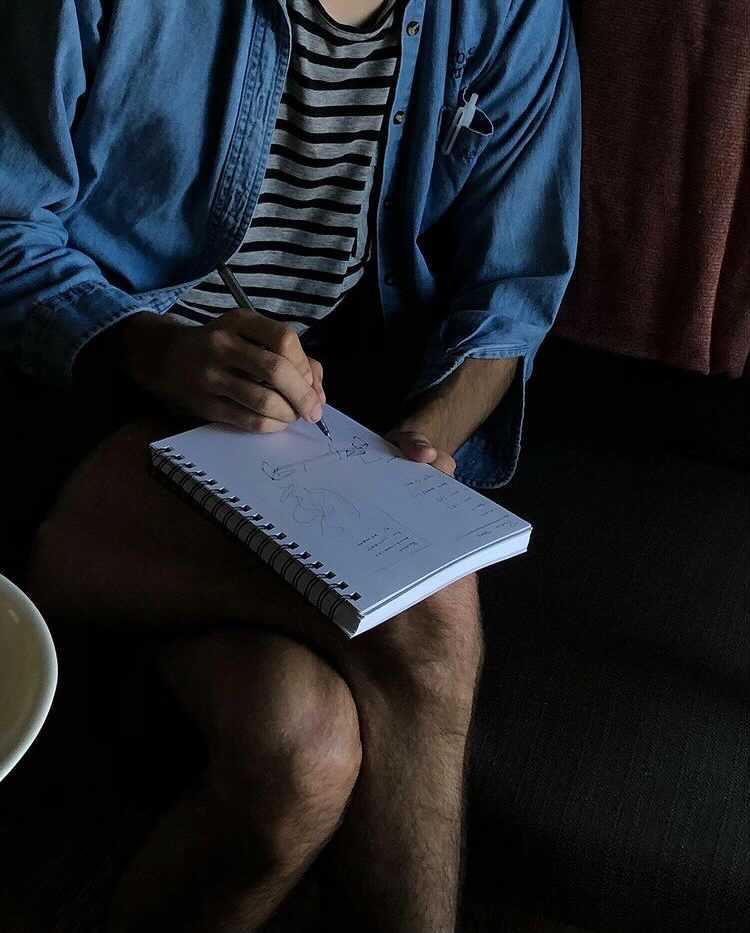
A few years ago, I wrote a piece exploring where ideas come from. I still can’t be sure, but I realized that I do know where they go – either away or into a notebook. So, whereas that piece wondered how ideas can find you, lately I’ve wanted to wonder about what to do when they do. As I think about the process of catching and growing ideas, I realize that the notebook is the vital step one to any great idea.
What is our relationship with notes? The first is the affiliation with schooling, studying, preparing for an exam. Goodness, I can feel the cortisol now. The second is in the realm of the clunky and modern words efficiency and self-mastery, it is the domain of work and productivity. It litters the mind with lists: To-Dos, To-Buys, and Five Year Plans. Podcasts, self-help leaders, and app developers all have a suggestion for you and your note keeping needs. It feels like there is a right way and a wrong way, and often we feel (or are explicitly told) that we’ve got it wrong. But of course this is nonsense, there is no wrong way to translate thoughts to paper. Sure, there are ways that are clearer, but so what? Sometimes being clear is best, but not always, it depends on your aim.
I make a casual distinction between note taking and note keeping. Note taking is necessary at times, and is mostly utilitarian. There is an art to note taking, but I will set that aside for now. For now, it suffices to say that note taking is the drab and imitative practice we are all familiar with from meetings, classrooms, and errands.
Note keeping is wonderful, effortless, and intuitive. It should feel like a private and intimate art. It should vary wildly, as a mirror to the Note keeper’s personality. Just as no two people are exactly alike, no two notebooks will be. Some notebooks will be messy and frantic, others will be organized and, yes, efficient. Some notebooks will be visual and contain many drawings, some may be specific and arduous while others are terse and mysterious. Notebooks from the same Note keeper will in fact differ from one another too. The phase of life, frame of mind, size of the pages, preoccupations, and all those subtleties that freckle our personal histories steer a notebook one way or another. Note keeping is an easy outlet for creativity, a protected space for baking or undercooked ideas. The birth place for all first drafts, the first first draft in fact. The notebook page is reality’s foyer, the threshold between the tangible world and the personal mind. It continually introduces you to yourself and can even make you more thoughtful and sincere. Like all writing, keeping notes helps you work out your idea of the world and yourself, privately and for yourself. It isn’t so serious, for once in the day you don’t need to judge the words you produce, just let them out.

Note keeping is the everyman’s memoir. And yet, we get bogged down in the impersonal and overwhelming industry of it. We routinely fall back to the main trail of note taking rather than exploring our own mental paths and methods. Do not let your notebook be overrun with duties or run by the pressure of an imagined audience. Do not let the “top” lists for note apps, notebook types, and specific pens distract you. Of course, I do find it fun to experiment with notebook types and pens. And there are honest Note keepers sharing their best finds and methods. Personally I usually like the little notebooks from Moleskine or Muji, and Muji’s transparent 0.7 mm pen. Lately I have been using the Mead Cambridge 3 x 5 writing pad and loving it, but even a napkin is a holy tablet when struck with a sacred and evaporating idea. You got to catch that damn thing, anything will do. This is the spirit of note keeping.
My desk has a few Post-It notes and envelopes laying around from sudden spurts of creativity, which I usually transcribe (or simply stick) into a notebook at a later point. I’ve kept a notebook on me, for the most part, for seven years now. I remember being told I looked like a Mormon out spreading the word with my little moleskin poking out of my short sleeved shirt pocket (at the time I also rocked prescription Club Masters, so I can’t fault the comparison really). What I have noticed is at first you don’t have much to write down in a day. At first it is a hodgepodge of little reminders for yourself, but gradually more “serious” things begin to populate the pages. I guess what I mean is that gradually the pages begin to be filled with more intimate matters. Not exactly private in the diary sense, but more ambitious or sincere. Your real goals come to the surface, your real stresses too, and your silliest ideas become worthy of keeping.
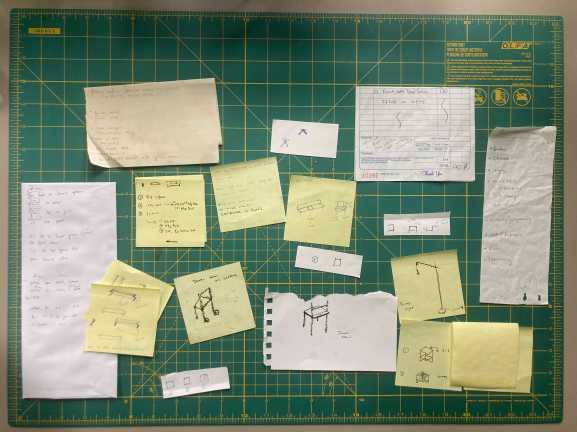
Beyond the type of things I write down, I’ve also noticed that ideas seem to come more often now that I have a safe home for them. Maybe the number of ideas hasn’t actually increased, maybe I am simply better at noticing when an idea comes walking by and am a better host for them. It has gotten to the point where I feel a tinge of panic when I notice an idea and don’t have the time or ability to give it a home. Luckily the iPhone has made it so that an idea always has a place to stay, even if in the motel of notebooks, the Notes app. The worst case of this is when some spontaneous melody comes into my head and I can’t catch it in my voice notes, whether because my phone is dead or because I am with other people. I have routinely snuck off to a private corner of the grocery store or a restroom to catch one. They usually turn out to be silly in retrospect, I don’t want to make it seem like I am a factory of brilliant ideas that I cannot let slip away… but still I am compelled to give them their fair chance.
Of course note keeping is now an analog method for recording things. Like other analog approaches, there are benefits and drawbacks. The obvious drawback is the lack of a search bar to help navigate your notes, but I find with a notebook I am much more familiar with my recent thoughts. This is why I called the Notes app the motel of notebooks. Those notes are lifeless, cold, and easily neglected (I am still grateful to have a place with near 24/7 availability for ideas). Despite having a search bar and cleanly organized folders, I interact with an individual note far less than I would if it were handwritten on a page. This is because with a physical notebook, I get to flip through the pages to reach a new one, and in doing so get to briefly revisit older ideas and notes. It is also just cool to see your own handwriting every day, and the way we think (or at least the way I think) is very different depending on whether I am writing or typing. Typing is too easy to delete, writing is more continuous and fluid. Physically writing out ideas lends a kind of romance to ideas and forces you to be less self-critical initially, it makes your ideas unique to you the person. The misspellings and slashed out words make the thinking clearer and familiar. Jack Kerouac would write out his poems by hand and type his novels. Perhaps it was partly this distinction Truman Capote was aiming at when he said of Kerouac’s work “that’s not writing, it’s typing.” Strange and ethereal ideas should be captured by hand, not keys. There is nothing more ethereal than translating thought to paper. Even though this line of thinking can seem overly sentimental (after all it is the content that matters more than the medium) it does seem much more interesting to recover your grandfather’s old notebook than to find a word file they say he made.
As I was flipping through my old notebooks I realized that note keeping is a time machine. You can find the origin of an idea and marvel at how such a small seed could make such a large tree and how long it can take to grow. Or revisit the stress that you used to struggle with, the idea you thought would change the world, the old routines that felt permanent, or the connections between disparate happenings you couldn’t see while in the ennui of the everyday. While wondering how to end this, or rather when to end it, I stumbled on another jotted line in an old red notebook from 2018.
“less really is more when applied to writing and art… better to end early than drag on or overstay your welcome.”
So, on that note…
——————————-
Image 1 taken by Camilo Herrera Matiz
Images 2 + 3 are my own.


 polymathematics
Leave a reply to Jake Weber Cancel reply