

Introduction
Instead of thinking hard and deciding what the perfect career would be for yourself (or the perfect major, courses, side project, etc), look at your options and move towards the one that seems cool or interesting to you in this moment.
After spending some time there, reevaluate. What aspects of this hobby, project, or job were you right about? Notice all of the interesting parts of it that felt easy to you (felt easy != effortless). Notice when you were most engaged or curious, notice which parts you found yourself thinking about when you weren’t actually working on it.
Now notice what aspects of this hobby, project, or job you were bored by. Which parts made you feel like Sisyphus, pushing a boulder up the hill for no discernable reason? Which parts did you think you’d love before getting involved, but it turned out you didn’t? Which parts did you despise?
Then, when it feels right, look around and find another thing that seems cool or interesting to you in this moment. If you see more than one cool thing you might like to do and are having trouble deciding which to go for, look at your list of the good and bad parts from your previous thing and pick the option that seems to minimize the bad parts from your list (you could be wrong about which option minimizes the things you don’t like, but at least it isn’t a blind guess).
Repeat this process forever. Hop from cool thing to cool thing as you get better at determining which cool things will actually be cool before you start them. This is how to live your ideal life.
Learning the way
This is what I dubbed the Lily Pad approach to life in a text conversation with my sister. It has sort of been internalized in me for a long time. At first I was scared it was a rationalization since I didn’t know what I wanted to do with my life by the time I was 14. Some kids are shooting for Medical School by then. I liked a lot of different things and the essay I wrote that helped get me into NYU’s engineering school was actually about how I refused to “pick” amongst the different interests inside of me. You may also notice that the name of this site embraces that concept too.
I later found out two things. The first is that many if not most of us feel like we aren’t doing the perfect thing at this moment, we feel a longing to find our purpose. We ask ourselves how can we get closer to a fulfilling career or life. And we tend to be drawn to many things, not just one ultimate goal. The second thing I found out is that there is a whole group of people out there who have found the Lily Pad approach too, and that maybe it wasn’t just a fun lie that made me feel better but was truly useful. The first other voice I heard discuss this was Hunter S. Thompson I think. There is a pretty famous letter Thompson wrote, wherein he gives advice to his friend who is “lost in life”. In the letter Thompson essentially says don’t pick a goal to achieve and then conform to that goal, but rather find the kind of person you like being and conform your goals to yourself. This isn’t a perfect framing, but it liberated me at the time hearing someone else suggest that you don’t need to find inflexible goals in life.
“As I said, to put our faith in tangible goals would seem to be, at best, unwise. So we do not strive to be firemen, we do not strive to be bankers, nor policemen, nor doctors. WE STRIVE TO BE OURSELVES.
But don’t misunderstand me. I don’t mean that we can’t BE firemen, bankers, or doctors— but that we must make the goal conform to the individual, rather than make the individual conform to the goal.”
Then, I heard a version of the idea articulated again by Neil Gaiman in his commencement address at University of the Arts, which is even closer to the Lily Pad theory I had floating around in my head. He used the metaphor of a distant mountain on the horizon, saying that in life you just need to move with the intention of getting slightly closer to your mountain overtime. Here, the mountain represents Thompson’s idea of “striving to be ourselves”, the ideal life loosely defined as it always is, as a mix of vague ambitions, warm feelings, a hodgepodge of loosely related goals, and a general hopefulness. With his usual charm, Gaiman put me at further ease that I was onto something. In this framing, when you are having a hard time finding your next Lily Pad, ask yourself if it takes you closer to or further from your mountain. This was great to hear, but I still felt I had many mountains, and couldn’t figure out my ultimate mountain.
Lastly, and most recently, I heard similar themes from Paul Graham in his essay ‘What You’ll Wish You’d Known‘. That was an essay prepared to be read to high school students. In it, Paul advises several things: don’t wait to start cool things simply because you are young, focus on finding what sorts of things you like rather than what you want to do, and finding great questions. But the heart of the essay is Paul’s metaphor of “staying upwind”. If in life you are on a glider (with no engine), then you should try to stay upwind. When you get downwind, you close yourself off from certain opportunities, and your options of safe landing spots narrow.
“Instead of working back from a goal, work forward from promising situations.”
The above quote from Paul’s essay is the Lily Pad theory – and relieved the tension of finding an ultimate mountain (or goal) that I felt in Gaiman’s approach. With the Lily Pad theory you need only hop from various promising situations and over time will optimize for your strengths and interests. As you do this, a clearer picture of your ideal life will form, and you will get better at choosing which Lily Pads you want to hop to. You never need an ultimate goal, you just keep improving your life with the data from your latest job, project, hobby, or other preoccupation.
But what about right now? What if you have no clue what you like? How do you pick your first Lily Pad? I mentioned in the introduction that all you need to do is pick something that seems interesting or cool to you at this precise moment and do that thing. But let’s look a bit deeper.
How to start
If you are having a hard time identifying where to start (your first Lily Pad), there are several tricks. But it is worth mentioning straight away that you can literally start anywhere. You will quickly find out what types of things you like and hate based on your first pick. But it helps to get at least somewhat close to an enjoyable first Lily Pad, so there are some tricks to help you.
Paul gives the following advice: “The best protection is always to be working on hard problems. Writing novels is hard. Reading novels isn’t. Hard means worry: if you’re not worrying that something you’re making will come out badly, or that you won’t be able to understand something you’re studying, then it isn’t hard enough. There has to be suspense”.
Imagine two things seem cool to you at this very moment, but those two things are very different. Imagine one option is working on a side project that involves automatically saving all your open tabs from the week to a notes app and another option involves collaborating on a friends T-Shirt design business. Both seem cool to you (this is very important, this example doesn’t work when comparing one thing that seems cool to another that is a real option, but that seems dreadful). Let’s suppose you have never written a single line of code in your life but that you are super good at Photoshop or Adobe illustrator. In this situation, I’d say you should go for the software project. Doing so will force you to learn many more new things than the T-Shirt route. You will explore new concepts, interact with new communities, get a better understanding of how you like software and programming, and will likely feel more fulfilled if you actually pull it off than you would if you helped your friend with Photoshop or Illustrator.
Another trick from Paul comes from one of his recent tweets: identify what comes easy to you that is hard for others.
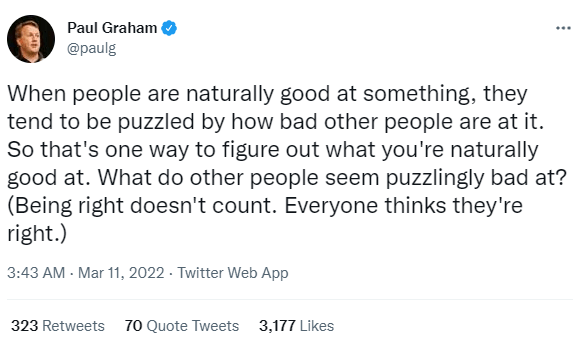
That trick has been called finding your “unfair advantage” by various people. I’ve also heard Tim Ferris recommend asking friends and family for help identifying your natural abilities. You will want to look for things that come easy to you when compared to others. Watching Netflix comes easy to most of us, so it isn’t unique to you or especially productive. Remember, hard things are hard for everyone (mostly), but there are things that are less hard for you on balance. Look for those. Another related trick to this is to investigate what you do when you don’t want to do what you’re “supposed to be doing”. What do you do to procrastinate (discard the unproductive answers)? For example, I am writing this post to procrastinate an item on my to-do list (I won’t say which). Writing is fun for me and I don’t view it as a chore. As I mentioned earlier, it doesn’t mean writing is effortless or easy. If I felt that way I’d be concerned, because it would probably mean I was writing horribly. Good writing is hard for everyone, but for me it also happens to be fun. I enjoy the hard parts. That isn’t true for everyone, so I’d say writing is one of my natural interests or strengths.1
Another trick I have heard on some podcasts is to remember what you were drawn to as a young child. That one I am a bit more skeptical of and it seems harder for people to come up with decent answers, but it has worked for some which is why I mention it.
Lastly, here are some questions that can help you interrogate potential projects or interests:
- “Would I do this thing even if it “failed”?2
- “Would I do this thing if the reward for succeeding was simply getting to do more of this thing?”3
- “Would I do this if I were 10x richer than I currently am?”4
- “Would I still do this if it were universally sneered at or mocked?”5
Remember, these tricks are simply for identifying the kinds of things you like so that you can start from a decent Lily Pad. If you loved Legos as a kid, I am not saying you need to monetize playing with Legos (although it has been done). But maybe that means you enjoy following detailed instructions, forming complex things from simple parts, or are better at tactile learning. So you can use that information to help you find potential Lily Pads. It is also important to recognize that it is rare to find something that encapsulates all of your interests, especially in the beginning. The questions and tricks above are meant to help get you going, but don’t get discouraged if your first few options don’t seem like a perfect match. In truth, it doesn’t really matter if you are wrong about what you like when you choose a first project, being wrong is data. You will quickly feel when you are wrong and can use that feedback to hop to your next project (that’s the whole point of the Lily Pad approach). There is an analogy to this in mathematics called Hill Climbing. The technique is “an iterative algorithm that starts with an arbitrary solution to a problem, then attempts to find a better solution by making an incremental change to the solution. If the change produces a better solution, another incremental change is made to the new solution, and so on until no further improvements can be found.”6 You can optimize to solutions even when you start very far away from the solution. So don’t stress, just start.
Better hopping
I will add, it’s important to not hop to your next thing too early though. As I said, even things we love will be challenging (or rather we love easy things and hard things, but the hard things we love tend to be the most fulfilling). Don’t mistake that challenge for disinterest and hop too soon (if you feel the desire to hop at the challenging moments of a project, note why, it is valuable data!). Find a good finishing place for a project before moving on. If you quit too early you will have poorer data for optimizing. Tim Urban frames this as cement-shoes versus wing-shoes. Some of us tend to quit too early, some of us tend to keep going even when it’s time to quit.7 And even when you do find something that feels perfectly suited for you, there will be some menial, boring, and even dreadful aspects to it. That is just a part of working on things, so set reasonable expectations using proportions of great to dreadful.
One last piece of advice is document your projects publicly if you are comfortable with that (if not, I still recommend you document privately). Doing this achieves several things.
- First, it lends an air of seriousness or pride to your projects or hobbies. At least for me, I tend to diminish my side projects in my own head as unserious or “just messing around”. This makes them easier to abandon and harder to see the seed of something bigger in them (although there is a benefit to this too8).
- Another thing documenting does is practical. It can help you land your next Lily Pad (a job, acceptance into a program, etc). Unfortunately much of the world still views careers and “life purposes” as a linear road towards success, and people want to see the checkpoints along the way. They like hearing about your “map” and how well you’ve navigated towards your destination of ultimate purpose. Documenting your projects makes them feel satisfied and trust that you aren’t just slacking off.
- Documenting your projects also holds you accountable (to yourself or other people). When I know I already documented the beginning of a project, it motivates me to make progress so that I don’t have to delete an unfinished project document from my computer, Notion app, or website. Another important benefit of documenting is that it reassures you that you are making progress. As a Lily Pad hopper, as opposed to the road map folks, you may feel uneasy at times that you are wasting your time and not making the kind of progress you should be in life. When you want to be a doctor, the steps to get there are pre-defined so it is easy to evaluate your own progress. But when you are simply doing things that interest you and growing over time, it is hard to recognize how far you’ve come. Documenting helps with that.
- I could probably keep thinking of benefits to documenting your work, so I will end with a list of benefits instead of going on and on: it can attract people with similar interests to you, it can give you new ideas for your next project, it can offer the chance for beneficial feedback or criticism and make you work stronger, and it provides a record of projects for you to investigate and find through lines in.
That’s the Lily Pad approach to life. Don’t feel bad when you see the rare individuals who knew what they wanted to be and took linear steps to be that. I think most of us are curious frogs hopping along.
footnotes
1. I’ve even heard this as a productivity tip: having multiple projects is useful because when you want to procrastinate on one you can work on the other.
2. Tim Ferris asks “what would I do if I knew I could not fail?” That is good too. I think he had a guest on once who was the first person I heard flip it to “what would I do even if I knew I’d fail?” It is also worth mentioning in this little footnote that “Systems Thinking” applies here. Pick things where even failure is a success.
3. See Tom Sachs’ “the reward for good work is more work”.
4. This aims to remove the financial reward of many paths that we can pretend aren’t the reason we are into something.
5. This aims to remove the social value or respect for many paths that we can pretend aren’t the reason we are into something. Parents, peers, and the respect of strangers or loose acquaintances all influence our decisions of worthwhile pursuits. Some of that is valuable, if large groups of people mock something they may be right too, but be careful with this gauge. Another aspect of this question is that it helps provide caution when interested in a trend.
6. https://en.wikipedia.org/wiki/Hill_climbing
7. https://mobile.twitter.com/waitbutwhy/status/1500628261591822336
8. When something is seen as a mere hobby or “side project” it is easier to get through the early phases of the work, which are often clunky and small in scope. Having the shield of calling it a hobby or side project helps convince yourself to keep going and inoculates you from the pressure of peers’ judgement (“Oh, you mean it just grabs the URLs and saves them to a notes app?”).

 polymathematics
Leave a comment